Common Problems
A Dryer That Stops After a Few Minutes Is Telling You About Air
The practical maximum for a rigid metal run is usually quoted around twenty-five feet, and every ninety-degree elbow costs roughly five feet of that while every forty-five-degree elbow costs about two and a half — so a run with three sharp bends is already most of the allowance before it leaves the room. Flexible foil ducting is worse than rigid and should be kept as short as possible. But the number that matters on this make is not in the manual, it is on the display: LG measures the restriction in its own exhaust and reports it as d80, d90 or d95, where the figure is a percentage of blockage and higher is worse. d80 is the first warning and an hour's work. d95 means the machine is close to shutting itself down. In South Florida the blockage is usually not the duct at all but the flap on the outside wall, which corrodes half open and packs solid behind.
The full guide
How long can LG dryer vent be, and what the number on the display means
The usual figure for a rigid metal run is about twenty-five feet, and that allowance is spent faster than people expect: every ninety-degree elbow costs roughly five feet of it and every forty-five-degree elbow about two and a half. A run that leaves the back of the machine, turns to get into the wall, turns again to travel along a joist and turns a third time to reach the outside has already used fifteen of its twenty-five feet on corners.
Flexible foil ducting is worse than rigid metal at every point — the ridges catch lint, it crushes when the machine is pushed back, and it sags into low spots that hold moisture. Where it cannot be avoided, keep it short and never bury it in a wall.
But on this make there is a better number available than anything in a manual, because the dryer measures its own duct.
The number LG puts on the display
Most makes leave the owner guessing about the exhaust. LG measures the restriction and reports it as a code beginning with d, where the figure is a percentage of blockage and higher is worse.
d80 is the first warning. At this point the lint screen, the housing under it and the first elbow behind the machine account for most of it, and an hour with a vacuum crevice tool and a brush usually clears it.
d90 means the machine is working noticeably harder. Cycles get longer, the cabinet runs hotter than it was designed to, and the load comes out damp from a program that used to finish it. This is where the whole run needs doing rather than the first three feet.
d95 means it is close to shutting itself down to protect the thermal cutoff. At this point the duct is packed rather than dusty, and it is worth understanding that a restricted dryer is not merely a slow dryer — it is a machine running hot with lint compressed into the run.
Why it is nearly always the flap outside
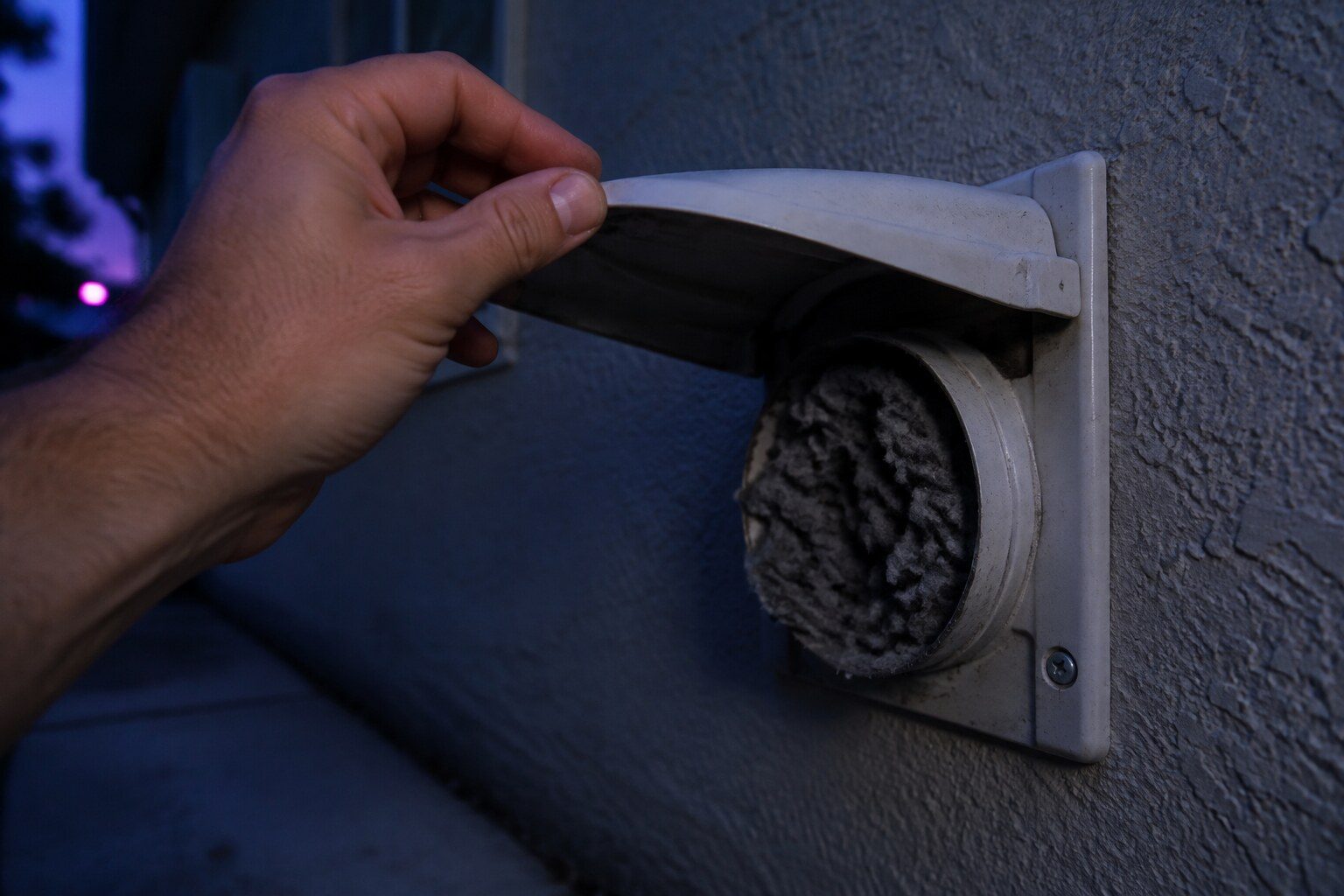
Go outside and find where the duct leaves the building. Run the dryer and hold your hand near the hood: there should be a strong, warm flow you cannot mistake.
If there is barely anything, the duct inside is probably fine and the hood is the blockage. In a coastal city the flap corrodes, seizes half open, and lint packs behind it into a felt mat that no amount of work at the machine end will touch. Painted-shut flaps are almost as common in older buildings, and screened hoods — a mesh fitted to keep birds out — clog within a season.
That is a five-minute discovery that saves an entire service call, and it is the single most useful thing an owner can check on a vented dryer.
Why this climate is different
A dryer works by carrying moisture away rather than by evaporating it in place: heated air picks up water from the load and leaves, taking the water with it, and new air comes in behind. Everything about drying performance depends on that flow.
Here, the air being pushed out is going into air that is already close to saturated. The lint traveling with it arrives damp instead of dry, and damp lint mats to the duct wall rather than blowing clear. That is why the interval in a manual written for a dry climate is optimistic on this coast, and why a run that was fine for three years can close in one wet summer.
If the machine is ventless
None of this applies. A heat pump dryer has no duct at all — it condenses the water out of the air and collects it in a container or sends it down a drain — and the equivalent maintenance is the condenser block, two lint filters instead of one, and the condensate path. LG codes a blocked condensate path as drn or OE, and a full water container stops the machine by design.
That is a different page and a different set of habits, and it is worth reading if your dryer sits in a closet with no vent behind it.
What to do this week
- Clean the lint screen and the slot it sits in. Both.
- Pull the machine out and disconnect the duct. Look at the first elbow.
- Go outside, run the dryer, and put your hand near the hood.
- If the flap does not move freely, that is the finding, and it does not need an appliance engineer.
- If the display has shown a d-number, act on it the first time rather than the third.
If it turns out to be a repair
What this leads to, and what it costs
Every job on this site is priced the same way: an on-site diagnostic first, the figure agreed in writing before anybody starts.
-
Dryer not drying
This is an air problem far more often than a heat problem, and the two feel identical from the laundry room. A dryer works by carrying moisture out; if the air cannot leave, the machine heats a drum full of humid air and the clothes stay wet no matter how long it runs.
- Air first: the screen, the duct, and the vent outside
- LG measures its own duct restriction and reports it as d80, d90 or d95
- A ventless heat pump machine has no duct — for those it is the condenser and the water
-
Dryer error code d90
LG dryer error code d90: This is one of the more useful things LG does. Every spelling LG publishes for it, which machines can raise it, and what to do next.
What this one means -
Dryer vent cleaning
The single most valuable thing that can be done to a vented dryer in this city, and LG makes the case itself: it measures the restriction in its own duct and reports it as d80, d90 or d95. A restricted dryer is not just slow. It is running hotter than it was designed to with lint packed into the run.
- LG measures its own duct and puts a number on the display
- The wall hood outside is the blockage more often than the duct inside
- It is a safety job as much as a performance one

Questions people ask about this
Can an LG dryer be side vented?
Most can be converted to exhaust from the side or the bottom rather than straight back, and the kit and the instructions come with the machine. It is worth doing where it removes a sharp elbow immediately behind the dryer, because that first bend is where the run is tightest and the lint is wettest.
Is flexible foil duct really that bad?
It is much worse than rigid metal and it is not a small difference. The ridges trap lint, it crushes when the machine is pushed back, and it sags into low points that collect moisture. If it has to be used at all, keep it as short as physically possible and never conceal it inside a wall.
How often should the whole run be cleaned?
Once a year for most households here, and more often with pets or a long run. The reason it is more frequent in this city than in a manual written elsewhere is humidity: air leaving into air that is already near saturated arrives damp, and damp lint mats to the duct wall instead of blowing clear.
The machine is hot to the touch. Is that dangerous?
Take it seriously. A dryer that cannot move air heats the cabinet instead of the load, and the thermal cutoff exists to stop that becoming something worse. Stop using it, clear the duct, and if it still runs hot afterwards have it looked at rather than lived with.
Common Problems
More guides like this one
-
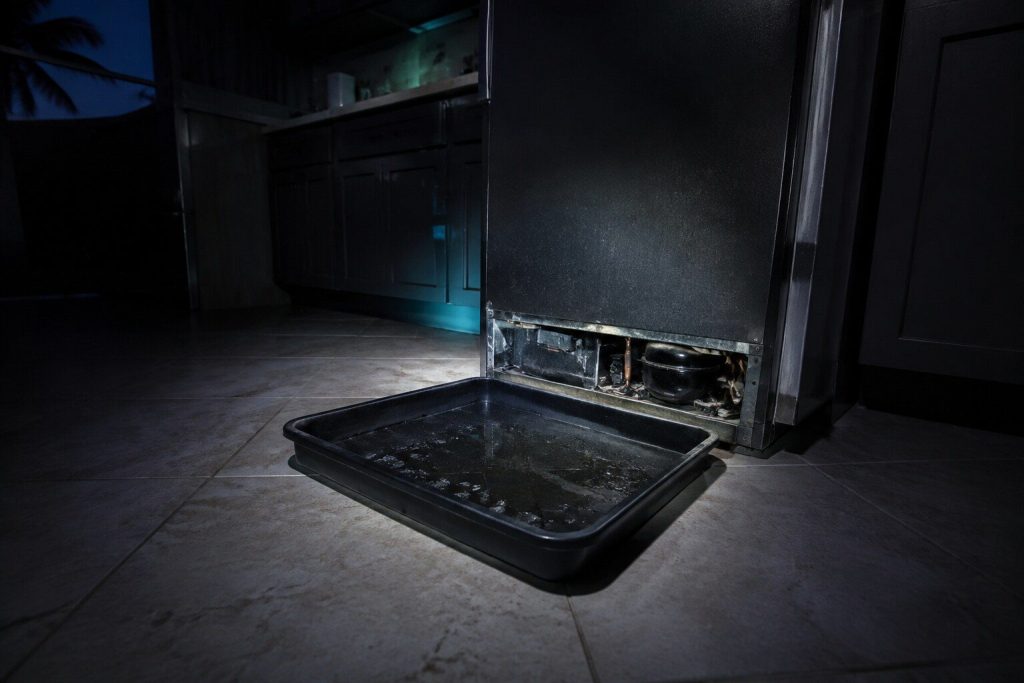
Water Under the Crisper Drawer, and the Tube Behind It
A refrigerator handles two entirely separate kinds of water, and where the puddle is decides which one you have before anybody is called.
Read more -
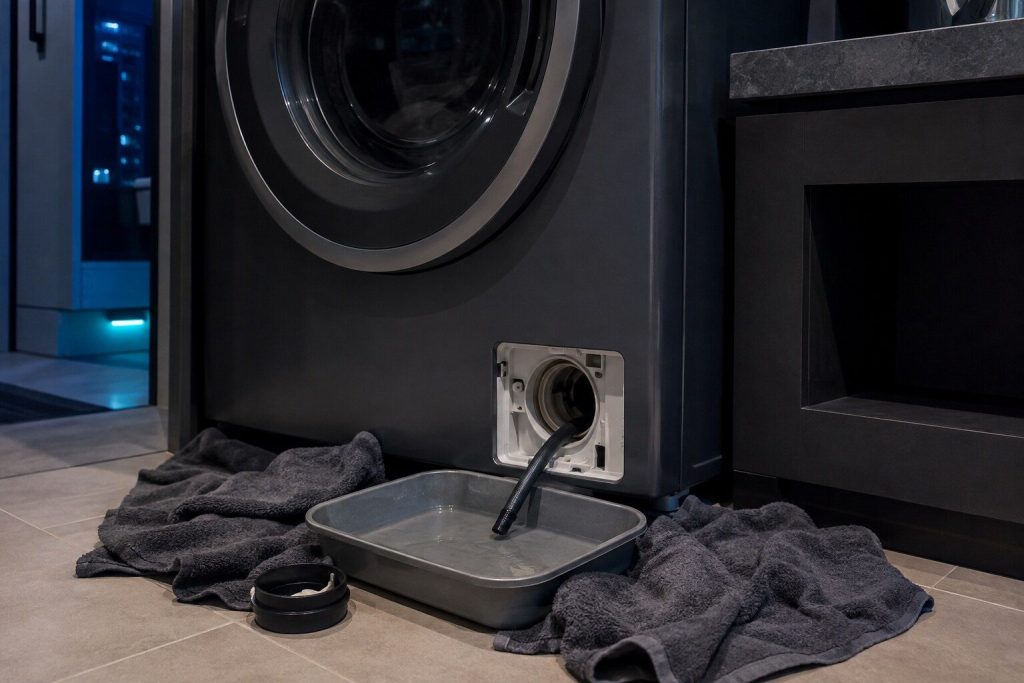
A Washer Stopped Full of Water: The Filter Nobody Opens
There is a filter behind a small door at the bottom of your washer, it is designed to be opened by you, and what comes out of it is usually the whole explanation.
Read more -

No Ice, But the Water Dispenser Works: What That Narrows It To
One ten-second test splits this problem in half, because ice and water share a supply and part company inside the door.
Read more
Tell us the model number and what it is doing.
This article is based on:
- Official manufacturer documentation
- Internal repair procedures
- Technician repair history
- Company quality standards