
Common Problems
Water in the Bottom of the Dishwasher: Four Places to Look
Scoop the standing water out with a cup first so you can see the bottom of the tub, then work through four places in order. One: the filter cylinder in the middle of the tub floor, which twists out by hand along with the flat mesh plate under it — everything the machine washes off the plates that does not leave through the drain ends up there, and a filter nobody has removed in two years will stop a perfectly healthy pump. Two: the drain hose behind the machine, checked for a kink or a crush where it was pushed back into its opening. Three: the connection at the sink, meaning the high loop or air gap and whether the kitchen waste itself drains freely. Four: the disposal knockout plug, which ships blanked off in a new disposal and stops a dishwasher draining from the day it is installed if nobody removed it. Only after all four is it the pump, and the pump tells you which — humming with no flow means blocked, silence means failed.
The full guide
How drain LG dishwasher: four places, in order
Scoop the standing water out with a cup or a jug first. You cannot diagnose a sump you cannot see, and there is rarely more than a couple of liters.
Then work through four places, in this order. The order is not arbitrary — it runs from free to expensive, and most machines are fixed before the second one.
One: the filter
Take the lower rack out. In the middle of the tub floor there is a cylindrical filter that twists out counter-clockwise by hand, and under it a flat mesh plate that lifts out with it. No tools.
Everything the machine washes off the plates that does not leave through the drain ends up there. In a household that scrapes rather than rinses — which is the right way to load a dishwasher — that is a meaningful amount of material, and it accumulates. A filter that has not been out in two years will stop a completely healthy pump.
Rinse both parts under a hot tap with a brush. Then feel carefully in the sump underneath — carefully, because a shard from a broken glass gets in there as easily as an olive stone. Put it back, turn it home, and run a rinse cycle.
For a large share of these calls, that is the entire repair.
Two: the hose behind the machine
If the filter was clean, pull the machine forward and look at the corrugated drain hose. Two things go wrong with it and both are physical.
It gets kinked or crushed when the machine is pushed back into its opening — a hose flattened against the rear wall of the cabinet is a common and invisible cause. And it can be pushed too far down the standpipe or fitted without the high loop it needs, which lets the sink drain siphon back into the machine.
Three: the connection at the sink
Follow the hose to where it joins the plumbing. There should be either a high loop — the hose rising to the underside of the worktop before it drops — or an air gap on the sink deck. Both exist to stop waste water flowing back into the dishwasher, and both can block.
While you are there, test the sink itself. Pour a jug of water down it with the dishwasher off. A kitchen waste that backs up or gurgles is a plumbing problem, and it will present exactly as an appliance that will not drain.
Four: the plug nobody removed
This one has a signature: the machine has never drained properly since the day it was installed.
A new garbage disposal ships with its dishwasher spigot blanked off by a moulded knockout plug. It has to be punched out and removed before the dishwasher hose is connected, and if the installer missed it — or connected the hose without checking — the machine has been pumping into a closed pipe ever since.
It is a two-minute job with a screwdriver and a hammer, and the plug has to be fished out of the disposal afterwards rather than left in there.
Then, and only then, the pump
Run a rinse cycle and listen at the machine.
A hum with no flow means the pump is running and something is stopping the water — go back through the four places above, because something was missed.
Silence where there should be a hum means the pump is not running: it has failed, or it is not being told to. That is a visit, the machine comes out and goes onto its back, and the part is a stocked item on this make rather than an order.
What the code says
LG publishes this condition as OE. If you searched for a different string and found nothing, that is worth knowing about this site: the maker prints several spellings for the same condition and every page here carries all of them, so whichever one your panel shows, you land in the right place.
If it turns out to be a repair
What this leads to, and what it costs
Every job on this site is priced the same way: an on-site diagnostic first, the figure agreed in writing before anybody starts.
-
Dishwasher not draining
The most common dishwasher call there is, and the cheapest cause is also the most likely. Everything the machine washes off the plates that does not leave through the drain stays in the sump, and the filter there is what catches it. A filter nobody has taken out in two years will stop a perfectly healthy pump.
- The filter in the sump floor is the answer more often than the pump
- OE is the code, and LG's own order goes from free to expensive
- A pump that hums is blocked; a pump that is silent has failed
-
Dishwasher error code OE
LG dishwasher error code OE: The single most common dishwasher call there is, and the good news is that the cheapest cause is also the most likely. Every spelling LG publishes for it, which machines can raise it, and what to do next.
What this one means -
Dishwasher drain repair
The most common dishwasher call there is, and most of it is labor rather than part. LG codes it OE, and the causes run from a filter that has never been taken out to a disposal knockout plug that was never removed when the machine was installed.
- Filter, hose, air gap and disposal spigot before the pump
- A pump that hums is blocked; a pump that is silent has failed
- A machine that has never drained since installation is usually the knockout plug

Questions people ask about this
There is always a little water in the bottom.
A small amount in the sump is normal and deliberate — it keeps the seals wet. What is not normal is water standing above the filter, water you can see without moving anything, or water that has gone cloudy and started to smell. Those are drainage.
It drains but very slowly.
Same list, earlier in its progress. A partly loaded filter or a partly kinked hose gives exactly this, and it is far easier to deal with now than after it stops entirely — which it will, usually on the evening you needed it.
Do I need to run the disposal first?
It is a good habit where the dishwasher drains through one. A disposal with food sitting in the grind chamber gives the dishwasher a partly blocked exit, and running it for a few seconds before a wash costs nothing.
How do I know if the sink drain is the problem?
Pour a jug of water down the sink with the dishwasher off and watch. If it backs up, drains slowly or gurgles, the plumbing is the problem and no work on the appliance will change it. That is worth establishing before a service call rather than during one.
Common Problems
More guides like this one
-
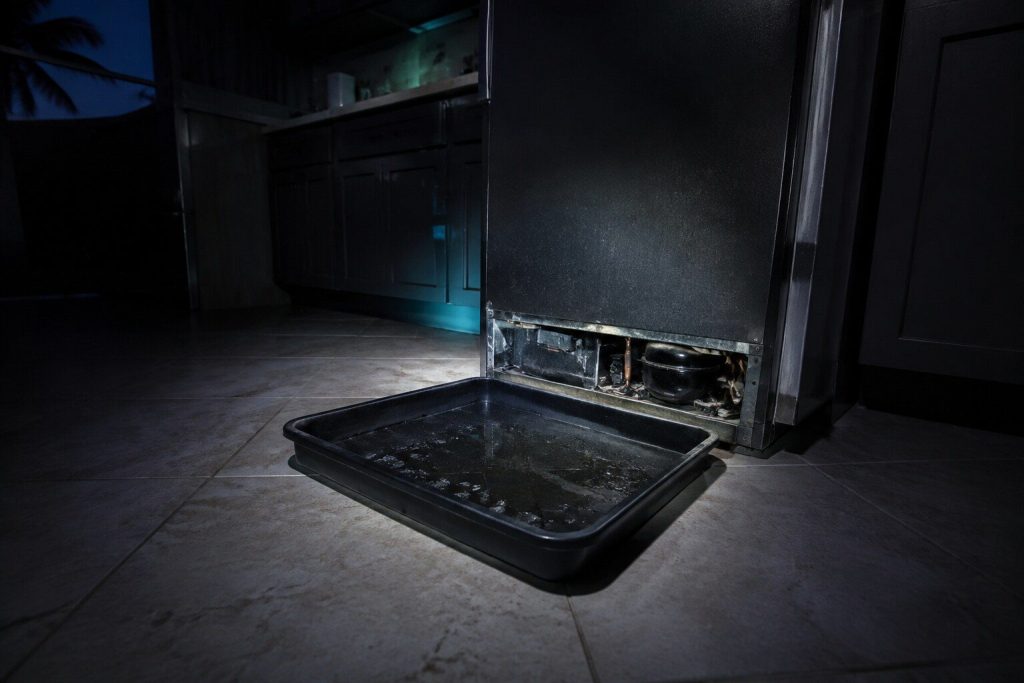
Water Under the Crisper Drawer, and the Tube Behind It
A refrigerator handles two entirely separate kinds of water, and where the puddle is decides which one you have before anybody is called.
Read more -
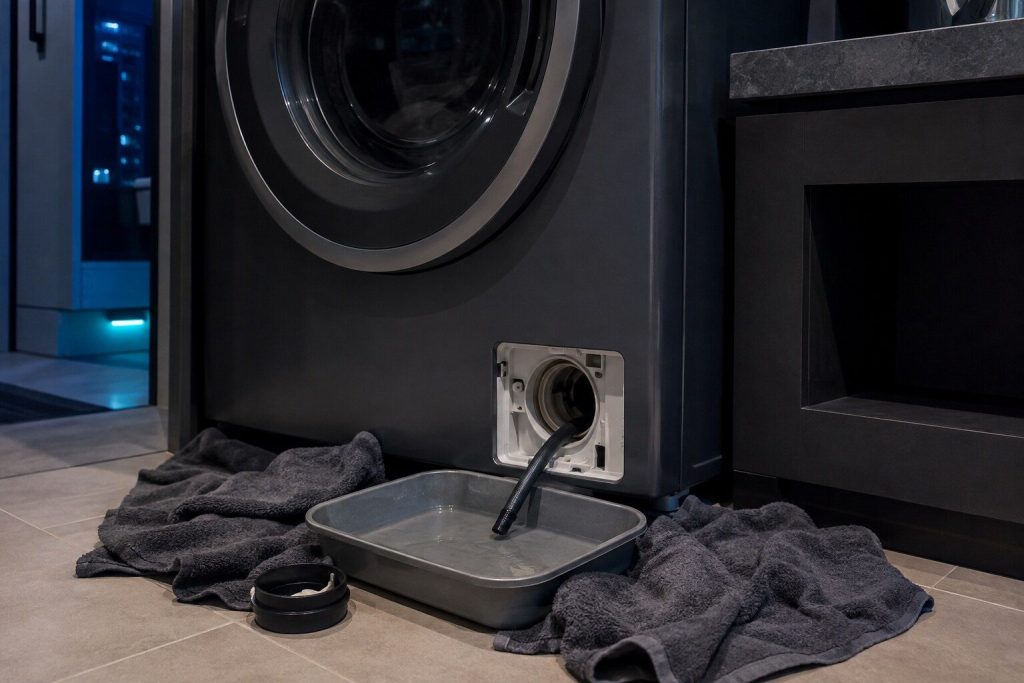
A Washer Stopped Full of Water: The Filter Nobody Opens
There is a filter behind a small door at the bottom of your washer, it is designed to be opened by you, and what comes out of it is usually the whole explanation.
Read more -
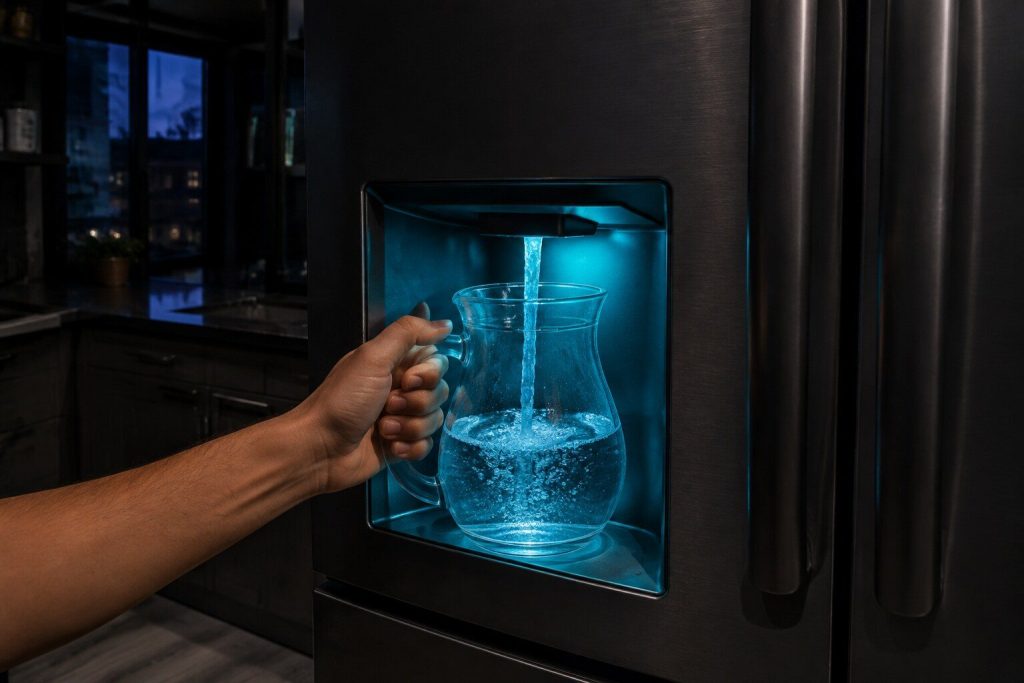
No Ice, But the Water Dispenser Works: What That Narrows It To
One ten-second test splits this problem in half, because ice and water share a supply and part company inside the door.
Read more
Tell us the model number and what it is doing.
This article is based on:
- Official manufacturer documentation
- Internal repair procedures
- Technician repair history
- Company quality standards