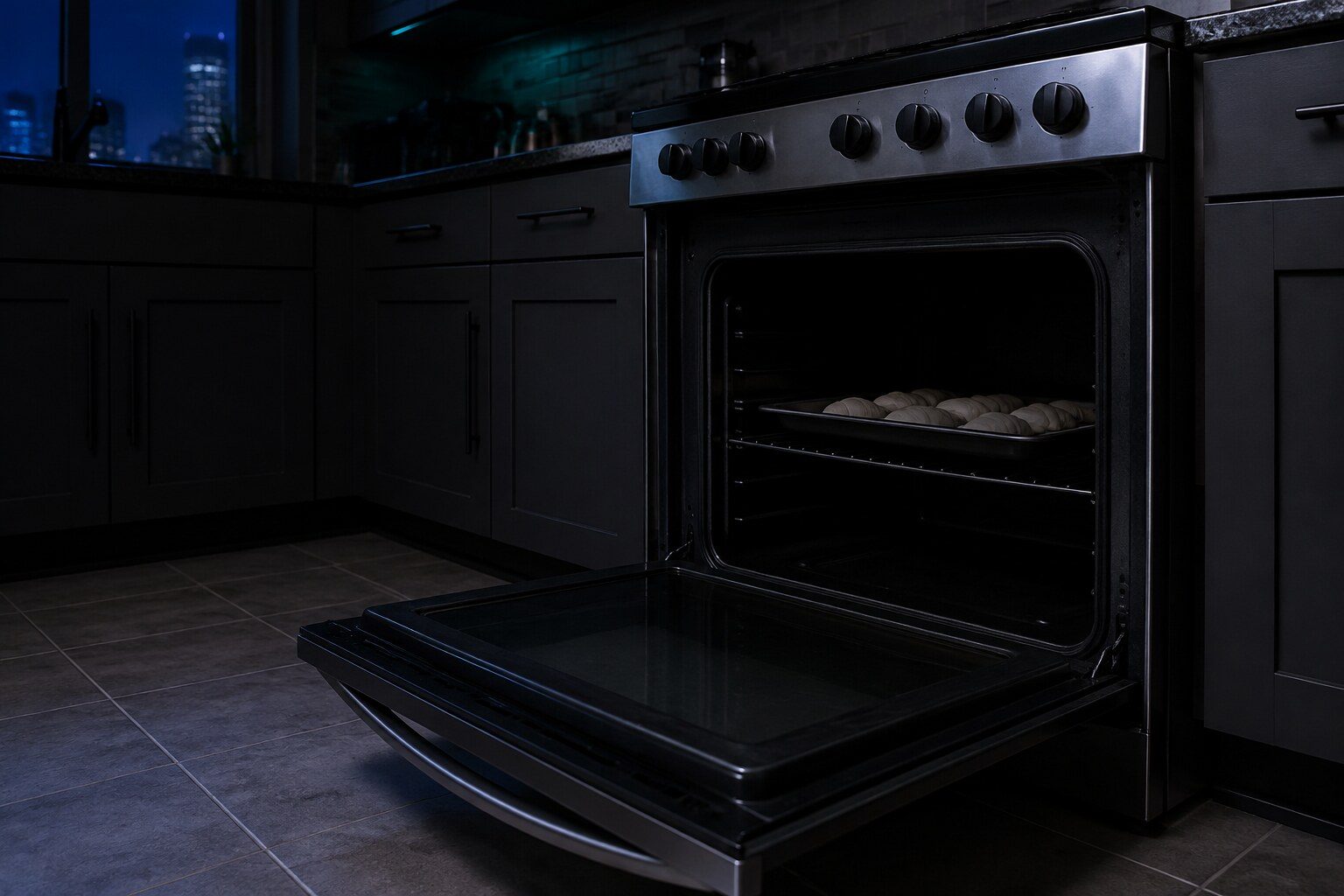
- “The F number names the cavity: F1 and F2 upper, F4 and F5 lower”
- “On electric, look at the bake element cold — a break is often visible”
- “On gas, an igniter that glows and never lights is the classic failure”
Symptom
LG oven not heating
An oven that will not heat divides cleanly on this make, because LG tells you which half you are in. A code means the machine has found something and named it. No code at all means the oven believes it is heating, which points somewhere different — at the element, the igniter, or the supply.
- From $95 diagnostic, credited to the repair
- 59 cities and neighborhoods covered
- OEM parts available on order
- In writing the price, before anything is opened
Four ordinary causes
What this usually turns out to be
Cheapest and commonest first, which is also the order we check them in. They sit hundreds of dollars apart, and only the unit settles which one is yours.
-
The bake element
Electric ovens. It fails open, often visibly.
Oven element replacement from $175 -
The igniter
Gas ovens. It weakens over years until it no longer draws enough current to open the valve.
Range igniter replacement from $185 -
The oven temperature sensor
F1, F2, F4, F5 and F16. The oven cannot measure, so it will not heat.
Oven sensor calibration from $135 -
The supply
A 240-volt appliance on one leg. PF after a storm is the polite version of this.
Diagnostic visit from $95
In five minutes
Before you call anybody
None of it needs tools, and all of it makes the visit shorter.
-
01
Write the code down first
F1 is not F4. The number says which cavity and which part, and it is the cheapest information in the whole job.
-
02
Look at the element with the power off
A break, a blister or a bright patch where it arced.
-
03
On gas, watch the igniter for a full minute
Bright orange and lit within a minute is healthy. Dull and unlit is the part.
-
04
Try the broil element as well
If broil works and bake does not, the supply and the board are both fine.
How it shows up
What people describe when they call
A shortcut
Narrow it down before anybody arrives
A description of the behaviour leaves a few possible causes. A code names the subsystem before anybody opens anything, which is why it is worth photographing before it clears.
If there is no code at all
LDE3011ST
LDEL7324SE
LDG3011ST
LDGL6924S
LRE3012SB
LREL6321S
LREN6321VE
LRG3021ST
LSWC307ST
LSWD300BD
LSWS300BD
LTIS7338XE
On a range, the data plate is behind the kick panel or on the frame under the oven door. On a wall oven, the data plate is on the side of the opening behind the door. All models
In more detail
About LG oven not heating
Look at the element before anything else
With the oven cold and the power off at the breaker, look at the bake element in the bottom of the cavity. An element that has failed is often visibly blistered, split or broken, and that is the whole diagnosis from the doorway. On a gas oven, start it and watch the igniter through the vent at the bottom: it should glow bright orange within a minute and the burner should light. One that glows dull and never lights is a weak igniter.
What it usually means, by the kind of LG appliance
LG sells one appliance in several forms — five shapes of washer, three kinds of dryer, four fuels of range — and the same behavior points at different things on each of them. A built-in side-by-side and an integrated column are not the same service situation, and a dual-fuel range and an induction range fail in different halves.
- Electric range — One bake element at the bottom, one broil element at the top. A visible blister or break in either is the answer.
- Gas range — The igniter draws current to open the valve, so a weak igniter means gas that never arrives. It is the commonest gas oven repair there is.
- Double wall oven — The code tells you which cavity before you open anything, which on a built-in saves drawing the appliance out twice.
The number is worth more than the symptom
Ovens on this make share one code list across ranges and wall ovens, and the numbers carry a location as well as a condition. F1 and F2 are the upper cavity temperature sensor; F4 and F5 are the lower one. F6, F9 and F19 are heating problems rather than measuring ones. F10 and F20 are the door lock, upper and lower. Reading that number before cutting the power is the single most useful thing a homeowner can do for the visit.
Why gas ovens fail this way
A gas oven's safety valve is opened by the current the igniter draws, not by a separate control. So an igniter that has aged and draws less current than it used to will still glow — brightly enough to look perfectly healthy — and still never open the valve. That is why 'the igniter glows so it must be fine' is the most common wrong conclusion in this repair, and why it is measured rather than looked at.
This article is based on:
- Official manufacturer documentation
- Internal repair procedures
- Technician repair history
- Company quality standards
Before you book
Questions about LG oven not heating
The oven works but everything burns on the bottom.
That is a calibration or sensor question rather than a heating one. Check with an oven thermometer on the middle shelf for half an hour at a set temperature. If it reads high, most of these can be offset from the control panel. If it swings wildly, the sensor is drifting and that is a part.
The cooktop works and the oven does not.
Useful information, and on an electric range it usually rules out the supply, because both run from the same 240-volt feed. On a dual fuel machine it rules out nothing — the top is gas and the oven is electric, and they are almost separate appliances in one cabinet.
Where we do it
Across Miami-Dade, Broward, and Palm Beach
Same terms everywhere we go: an on-site diagnostic first, the price agreed in writing, and the exact figure confirmed once we have seen the unit.
Neighborhoods people ask for by name